In Steve Johnson’s writing about the
internet, he states that it has been beneficial to us in that it has made us
more participatory both cognitively and socially. I agree with him in this
because with television, I usually would just watch is brainlessly and even
fall asleep to certain shows; but when I use the internet, I am usually engaged
the whole time because I constantly have to be clicking or scrolling through
things to get to whatever I want to see. Also, I believe that is beneficial to
me cognitively because it has challenged me to learn how to solve problems
using technology. I am not a very tech-savvy person so using a new search
engine or other tool the internet provides is always a challenge for me and
often requires that I use a few problem solving skills in the process in order
to figure out what I am doing wrong or what I need to perform to get my
computer doing what I want it to. Also, with Facebook for example, I have been
able to be more social. I never really used to keep
Tuesday, December 3, 2013
Internet, Internet Everywhere!

Thursday, November 21, 2013
Good News and Bad News
Today in class, after watching an episode of ABC News, the story that I though was more serious and well-researched was the one about the trained terrorists that snuck into the United States by pretending to be Iraqi refugees. This news is not only serious because of the danger behind the topic, but you can tell it was taken seriously by the news cast. In Klosterman's reading, he said that a lot of the time, the stories the news anchors tell is a matter of who calls them back first or who is willing to make a comment. If nothing is given, then they sort of just have to bull-shit their story and milk whatever they can out of whatever information they have to fill the time slot and still get some news out to the public. I do not believe that was the case with this story, though, because they had many clips showing different people commenting on the subject, which means they got a lot of different points of view. Also, a lot of the people who were interviewed were saying the same things, so this helped make what they were portraying to the public seem more likely to be true. On the other hand, a story that didn't seem as well-covered as this one is that of the 85 year old war veteran who was kidnapped when merely sight-seeing in Korea. The reason this story seems sort of "fluffy", as Klosterman would suggest, is because there wasn't a single interview shown by anyone who directly saw what happened, and just generally not very much information on the subject. One of the news anchor's said, "We all know one thing, he sure is the talk of his retirement home." Since this comment seems pretty irrelevant to anything the public would really be concerned about, it seemed as though the anchor was just trying to fill the time slot for this story by adding something...anything. I definitely will be looking more closely when I get my news for this kind of "fluff" and make sure it comes with a variety of perspectives and some type of notable attempt at bringing forth as much accurate information as possible.
Thursday, November 14, 2013
What Defines the Millenial Generation
 The Millennial generation, like
any, has its good traits and its not-so-good traits. One big example of the
not-so-good traits might be that, since technology is so prevalent in every
aspect of our lives, we are somewhat technology obsessed. People our constantly
posting pictures or commenting about their lives on social networking sites and
the majority of these posts are things that other people really either have no
business in knowing or don’t want to know. Such things are like: where you are
at right at this moment, what you ate for dinner, that you are mad at someone,
and so on and so forth. Now days, people
almost obsess over keeping up with their latest dramas or news on these social
networking sites and can often lose touch with things in the real world that
really matter. Although this example is very important and is seen happening to
kids, teens, and adults just about everywhere, I don’t think it is what defines
the Millennial Generation. I think a major event that would define the Millennial
generation, which just so happens to be one which harbors a “good trait” would
be the election of our first ever black president, Barack Obama. Although some
people don’t necessarily agree that he is even a good president, I think his
election was a defining moment for our generation because it shows the progression
of acceptance of diversity in this country and how much we have grown in this
sense. Now, not only are people more accepting to racial diversity, but
diversity in sex (like at the work place), mental\physical abilities, and
romantic partnership as well. This will be a general good for our future
because hopefully it will help lead to equality and acceptance amongst all
people in future generations, and help reduce a lot of the arguments and
fighting that still occur amongst the minority of people who still haven’t
caught on to the change.
The Millennial generation, like
any, has its good traits and its not-so-good traits. One big example of the
not-so-good traits might be that, since technology is so prevalent in every
aspect of our lives, we are somewhat technology obsessed. People our constantly
posting pictures or commenting about their lives on social networking sites and
the majority of these posts are things that other people really either have no
business in knowing or don’t want to know. Such things are like: where you are
at right at this moment, what you ate for dinner, that you are mad at someone,
and so on and so forth. Now days, people
almost obsess over keeping up with their latest dramas or news on these social
networking sites and can often lose touch with things in the real world that
really matter. Although this example is very important and is seen happening to
kids, teens, and adults just about everywhere, I don’t think it is what defines
the Millennial Generation. I think a major event that would define the Millennial
generation, which just so happens to be one which harbors a “good trait” would
be the election of our first ever black president, Barack Obama. Although some
people don’t necessarily agree that he is even a good president, I think his
election was a defining moment for our generation because it shows the progression
of acceptance of diversity in this country and how much we have grown in this
sense. Now, not only are people more accepting to racial diversity, but
diversity in sex (like at the work place), mental\physical abilities, and
romantic partnership as well. This will be a general good for our future
because hopefully it will help lead to equality and acceptance amongst all
people in future generations, and help reduce a lot of the arguments and
fighting that still occur amongst the minority of people who still haven’t
caught on to the change.Thursday, November 7, 2013

Thursday, October 31, 2013
Accidental Racist
The song “Accidental
Racist” by Brad Paisley and L.L Cool J was made to be a big deal, first of all,
because this song fused two completely different music genres together.
According to Chuck Klosterman’s reading, country music is supposed to sort of be
stories about the average Joe and simple, everyday life, while Staples’ argument
about hip hop states that it is mostly about murder, misogyny and materialism.
Clearly these two genres appear as though they wouldn’t mix well, but then
again, not all country songs and hip-hop songs are always about these kinds of
things. This means that Klosterman and
Staples’ ideas about the two could be considered stereotypical. “Accidental
Racist” breaks through the stereotypes of both genres by creating something
that is very different and unexpected, but even so, the song is still
controversial because the lyrics themselves bring cultural stereotypes into
play.
In the song,
Brad Paisley describes himself as looking the part of the typical southern
cowboy: wearing a white cowboy hat and a confederate flag t-shirt, while L.L
Cool J describes himself as wearing a gold chain. Both these statements are stereotypes of the
typical southerner and the typical person of hip-hop culture because not every
person categorized in either cultural group dresses the way these two men do.
Another reason this song is such a big deal is people reacted very negatively to
the fact that it brought up the issue of slavery very bluntly. Some people were
angered by the fact that this may have re-opened an argument that was already
long forgotten, and some people were just the opposite. L.L Cool Jay states in
one of his lines, “If you can forgive my gold chains, I can forget my iron
chains.” Some were angered by this statement because they thought it was
radical to agree to forget about something so important to our history in
exchange for not being judged by the way one dresses. Personally, I thought the
song had good intentions within its message, and people shouldn’t be offended
by this attempt at guiding two different cultures to better understand each
other. As a song, though, I thought “Accidental Racist” sounded bad and the two
genres did not fit very well together the way it was created.
Wednesday, October 23, 2013
"Intertextuality"
After learning about "intertextuality" from the "Bootleg Culture" reading, I realized that there is a ton of it out there, and I can't always say that I know exactly who wrote what, made what, or said what first! For example, just the other day, I heard this new song on the radio called "Dark Horse" by Katie Perry and Juicy J...or so I think. When trying to look the song up to add to my "Spotify" playlist for enjoyment purposes, it came up with a list of many versions of this song by different artists. I had no clue, and still have no clue, which one was even the original and who came up with it in the first place. Although the other versions were just as cool as Katie Perry's, it was sort of unsettling to me not knowing which one was really even "Dark Horse" the authentic.
This kind of "intertextuality" shows up everywhere in life. One popular example I can think of is with kids t.v shows vs. products made from them. For example, SpongeBob is a very popular t.v show, and not only is it that, but its characters come in snacks, plush toys, clothing, books, board games, video games, etc. and you never really know if the original creator of SpongeBob and the television series had anything to do with the designing or creating of any of them. This goes the same for other similar children's shows such as Mickey Mouse Clubhouse or Dora The Explorer. Some of the items sparked from these shows may not even be made by a Disney or Nickelodeon corporation, or even have to credit the person who originally thought of the characters or show ideas. There are so many items out there like this now that some people may not ever know, or even care where ideas originally came from, so long as they still get what their asking for.


This kind of "intertextuality" shows up everywhere in life. One popular example I can think of is with kids t.v shows vs. products made from them. For example, SpongeBob is a very popular t.v show, and not only is it that, but its characters come in snacks, plush toys, clothing, books, board games, video games, etc. and you never really know if the original creator of SpongeBob and the television series had anything to do with the designing or creating of any of them. This goes the same for other similar children's shows such as Mickey Mouse Clubhouse or Dora The Explorer. Some of the items sparked from these shows may not even be made by a Disney or Nickelodeon corporation, or even have to credit the person who originally thought of the characters or show ideas. There are so many items out there like this now that some people may not ever know, or even care where ideas originally came from, so long as they still get what their asking for.
Thursday, October 17, 2013
Looking back at this first semester so far, I feel that what
I have learned most, when it comes to popular culture, is how big of an
influence the media really has on our lives. For example: the media can
influence our relationships, what products we choose to buy, and more
importantly how we feel about ourselves individually and as a culture. When it
comes to relationships, Chuck Klosterman’s “This is Emo,” did a good job
explaining how the media influences our relationship expectations. He explains
that romantic movies (like the notebook) or even Disney movies often give us
these unrealistic ideas of what romantic relationships are supposed to be like:
with firework worthy kisses, surprises at every corner, and a happily ever
after. In real life, we are affected by this because we learn to expect these ridiculous
things from our partners that in reality just don’t happen every day. Therefore,
we get disappointed and chase to obtain something that may not even exist outside
of these movies. After reading the
Decoding Victoria’s Secret reading, I realized that sometimes products
themselves aren’t even advertised. When it comes to woman’s underwear, a sense
of sexiness and attractiveness to men is sold more prevalently than the actual
undergarments. This shows how influential advertisers can be on our product
choices as they play with our emotions and insecurities. Lastly, the media is
very influential in the way we look at ourselves and our expectations of
ourselves as a culture. For example, The Dove Study created a video showing a
very attractive female model and what goes on before the model would be shown
to the public. After extensive editing of an already beautiful woman, she then
artificially embodied the stereotypical features of what the industry finds
attractive. When people see models that all appear to look a certain way, they
become self-conscious and believe that this is the way they and people of our
culture are supposed to look like as well. I never realized how influential the
media can be on our daily lives, but after being sort of put into check by
these readings and videos, I noticed that I myself fall victim to this
influence as well.
Thursday, October 3, 2013
Masculinity and Violence
 In our
culture masculinity is often portrayed as the same as toughness. It almost seems
to be as though you just are not considered a man if you can't stand tall and
hold your own in a situation where your mental and\or physical strengths are
tested. More often than not, movies\television shows, etc. give these men the
opportunity to prove their masculinity (toughness) by placing them in physical
altercations in which violence is always the answer. For instance, many
superhero men in the movies or comics are shown as buff, handsome, athletic,
etc., as opposed to their usually scrawny looking enemies. Automatically, kids
who watch cartoons or read comics will assume the good guy is going to win
because he looks tougher and therefore manlier than the bad guy. What better
way to prove this theory than to place them in some sort of physical battle with
each other in which there are lots of "POW's" and
"KA-BLAM's", usually coming from the superhero’s fists. Then, the
superhero (the good guy) generally triumphs over the bad guy, giving off the
impression that he must have been tougher and therefore a superior man compared
to the opponent. Seeing things like this could make boys in our culture believe
that in order to prove their manliness, they must not only look the part of a
strong\buff man, but act the part too…when the time comes. I would have to side
with the APA in saying that the media could be influencing violence in kids. I
wouldn’t go to the extreme in saying that young men would go watch these
cartoons and immediately go beat someone up to show that they are tougher than
someone else, but if someone were to question their manhood; that is: challenge
them to a fight, they would probably be more likely to agree in order to prove
a point. Superheroes would never walk away from a fight with
their enemy. If they choose to walk away, then they send a message that the
other is superior and they are the weaker man. As boys seem to always be
looking forward to that day they can be recognized as a man, it is likely
that they will take the opportunity as often as they can to prove themselves
worthy. If the media is showing fighting and violence as an easy way to get
this recognition, then why wouldn’t they “knuckle-up” at first chance?
In our
culture masculinity is often portrayed as the same as toughness. It almost seems
to be as though you just are not considered a man if you can't stand tall and
hold your own in a situation where your mental and\or physical strengths are
tested. More often than not, movies\television shows, etc. give these men the
opportunity to prove their masculinity (toughness) by placing them in physical
altercations in which violence is always the answer. For instance, many
superhero men in the movies or comics are shown as buff, handsome, athletic,
etc., as opposed to their usually scrawny looking enemies. Automatically, kids
who watch cartoons or read comics will assume the good guy is going to win
because he looks tougher and therefore manlier than the bad guy. What better
way to prove this theory than to place them in some sort of physical battle with
each other in which there are lots of "POW's" and
"KA-BLAM's", usually coming from the superhero’s fists. Then, the
superhero (the good guy) generally triumphs over the bad guy, giving off the
impression that he must have been tougher and therefore a superior man compared
to the opponent. Seeing things like this could make boys in our culture believe
that in order to prove their manliness, they must not only look the part of a
strong\buff man, but act the part too…when the time comes. I would have to side
with the APA in saying that the media could be influencing violence in kids. I
wouldn’t go to the extreme in saying that young men would go watch these
cartoons and immediately go beat someone up to show that they are tougher than
someone else, but if someone were to question their manhood; that is: challenge
them to a fight, they would probably be more likely to agree in order to prove
a point. Superheroes would never walk away from a fight with
their enemy. If they choose to walk away, then they send a message that the
other is superior and they are the weaker man. As boys seem to always be
looking forward to that day they can be recognized as a man, it is likely
that they will take the opportunity as often as they can to prove themselves
worthy. If the media is showing fighting and violence as an easy way to get
this recognition, then why wouldn’t they “knuckle-up” at first chance?Thursday, September 26, 2013
"Football High" : A Documentary or Horror Film
In class we watched the Documentary entitled "Football High." While watching it, I could not help but to feel horrified at what I was seeing and hearing about modern day football. As the contents of the film itself were terrifying to me, I found it more terrifying that I am guilty of being just as oblivious to the real dangers of football and in fact have encouraged my 11 and 12 year old nephews to join in the barbarism by becoming members of our home town high-school's feeder program.
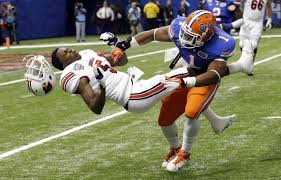 One of the big issues "Football High" presents is the safety of the football players as they are subjected to very hard hits every day in practice, and even harder hits in games that can cause major head trauma. One of these the film discusses is a disease called CET in which a player could have such severe brain damage that the likelihood for someone to develop depression, dementia, and even attempt suicide are increased. Concussions are a big concern and are a gateway to long-term brain damage as well. It was said in the video that according to the sensors placed in football helmets, high school players receive more contact to the head than even college athletes. It is also stated that these helmets are designed for the protection of fracture to the skull, but do not necessarily protect against concussions. The athletic director of one of the high schools in the film even stated that there are certain safety requirements that are required at the high-school level of football, but there are no penalties if these requirements are not met by the coaching staff. In one incident, a player named Garrett that was a member of the Shiloh Christian High-School Saints' football team received a concussion during a game and was actually released by an athletic trainer to play in the second half. Some high-school's don't even have an athletic trainer on staff due to the lack of money to provide for another staff member, and the coaches are expected to provide the medical attention and determine the health standings of their players.
Another big issue, that seems to be the overall, underlying theme of this documentary, is that football (especially at the high-school level) is becoming way too serious. So serious, in fact, that this same Shiloh High-School has 6 members of the coaching staff to attend to only 40 players of the team, not including private trainers outside of practice for agility purposes. Also, these coaches are having their players practice in 112 degree heat indexes, just to not miss one day of getting better than the opponent. Two high-schools in Arkansas, one of which again was Shiloh, each had a player pass out and have a heat stroke in the same season due to practicing in this kind of weather. Both boys were hospitalized in critical condition and the one from the neighboring high school was not lucky enough to make it out alive. Even after this incident, Will, the surviving boy from Shiloh, continued to play football. Kids should not be expected of putting their lives at risk for the sake of a sport, and this particular sport has proven to be extremely dangerous in may aspects.
These big issues are presented in the film as, just as I took them to be after watching: horrifying. As they are presented as such and the coaches\staff and players appear to know all these details, they still act as though it is part of the game and these types of things are inevitable. I think the big question the makers of the video want people to think about is what is being done about the horrifying aspects of this sport? Also, what can we do to get people to stop ignoring and playing through the pain when it is, in fact, something you should not be playing with. It is one thing to play through a couple bumps and bruises (not very complicated injuries), but when it comes to life and death situations...is winning really that important?
Another big issue, that seems to be the overall, underlying theme of this documentary, is that football (especially at the high-school level) is becoming way too serious. So serious, in fact, that this same Shiloh High-School has 6 members of the coaching staff to attend to only 40 players of the team, not including private trainers outside of practice for agility purposes. Also, these coaches are having their players practice in 112 degree heat indexes, just to not miss one day of getting better than the opponent. Two high-schools in Arkansas, one of which again was Shiloh, each had a player pass out and have a heat stroke in the same season due to practicing in this kind of weather. Both boys were hospitalized in critical condition and the one from the neighboring high school was not lucky enough to make it out alive. Even after this incident, Will, the surviving boy from Shiloh, continued to play football. Kids should not be expected of putting their lives at risk for the sake of a sport, and this particular sport has proven to be extremely dangerous in may aspects.
These big issues are presented in the film as, just as I took them to be after watching: horrifying. As they are presented as such and the coaches\staff and players appear to know all these details, they still act as though it is part of the game and these types of things are inevitable. I think the big question the makers of the video want people to think about is what is being done about the horrifying aspects of this sport? Also, what can we do to get people to stop ignoring and playing through the pain when it is, in fact, something you should not be playing with. It is one thing to play through a couple bumps and bruises (not very complicated injuries), but when it comes to life and death situations...is winning really that important?
Thursday, September 19, 2013

Chuck Klosterman, in his reading "This is Emo" talks about an idea he has called "Fake Love." According to this idea, Klosterman thinks that the love we see in relationships between romantic partners on television and in movies is "fake" in the sense that it is too perfect and unrealistic compared to what love is like in reality. Real love relationships often contain arguments, are not always helplessly romantic, and sometimes contain struggle to even maintain the same feelings for each other; whereas in the media, it is often portrayed that real love should leave you 100% happy 100% of the time. An example of this would be with in the movie 50 first dates with Adam Sandler and Drew Barrymore. In this movie, although the relationship is quite quirky to begin with considering Drew Barrymore's character's disability, Adam Sandler's character goes out of his way, every single day to keep Drew Barrymore's character happy and in love with him. He even makes her a video so that she won't forget how much he loves her and how happy they are. Although this is sort of a different example, it shows how hard Adam Sandler's character is willing to fight for love and for the happiness of his lady under any circumstance. Most people would be disappointed in reality to find that even though a future boyfriend or spouse may try hard at keeping the happiness, they may not do so in such a personal, deep, touching and romantic way that is portrayed through this movie.
Thursday, September 12, 2013
Sexy Violence
In Jean Kilbourne's video, "Killing us Softly," one of the points she makes is that in a lot of ads containing both women and male models now days, violence seems to be eroticized. This ad for Dolce and Gabbana's perfume "light blue" appears to embody this characteristic. Since the male model is coming from behind the female model, it can almost be looked at as sort of an attack of seduction. Based on the body language and facial expression of the female model, she looks almost as if she is resistant of his touch (as she appears to be tensely leaning away), and unsure of what he is doing. All the while the man looks very firm, with his stiff arm and serious countenance, that this woman is his, and he is going to take her with or without consent. With this, the oceanic background scene and half naked bodies is what brings sort of a sexiness and eroticism to this violent looking gesture, thus, proving Kilbourne's point.
Monday, September 9, 2013
We're Bringing Sexy Back
I think sexiness is very important in our culture today. I believe this is so because people always want to achieve greatness and become better versions of themselves, especially when it comes to visual appeal to others. I believe this comes into play in what people buy depending on how things are advertised in the media. For example: I'm sure many women would be perfectly content wearing "granny panties" every day of the week, but the media, especially television shows and underwear ads, is emphasizing the fact that granny panties are embarrassing and it's the see through, lace thong that's sexy and has all the men on edge. In Marie D. Smith's article "Decoding Victoria's Secret" she argues that the business is only such a success with women because, "[Victoria is] the best at giving men what they want visually." You don't generally see the Victoria's Secret models wearing belly button-high, nude, unflattering, undergarments; They are generally seen in some type of lacy, matching pair of undergarments that flatter their pushed up busts and perky bottoms. Thus, if these are the types of women men think are sexy and the types of underwear they consider men to think are sexy, then naturally, women are going to purchase from these businesses in order to make themselves qualify as sexy to men as well.

Thursday, August 29, 2013
Popular Happiness
Popular culture is related to happiness in the sense that it can be very influential to our thought processes when distinguishing what we think is going to make us happy. For example: there are countless commercials on television advertising all kinds of products and in almost every single one, there is a majestic looking male or female practically making love to the item and looking as though they haven't a worry in the world. For instance, in food commercials, the very attractive actors are most likely smiling\laughing while eating, and sometimes are even at the dinner table with the family, giving off the impression that they, while eating this food item\brand are having the best time of their lives and nothing could possibly bring them down. This is when the poor, depressed, individual sitting on the couch eating a "prepared on the fly" meal that was decided on 20 minutes ago thinks, "Maybe if I eat what they're eating, I'll look that good," or "I wish family was that happy at dinner...I MUST NEED THAT!" Thus, the buying begins in search of the magic item that will bring the family together in laughter and ultimately bring us that happiness we saw in those people on T.V. Yes, it sounds very stupid, but it's true; We would never get some of the ideas we have if not having seen or heard them through the television, radio, or in magazines. Turns out, we may just be perfectly content with what we have and are quite happy, but as soon as someone on a commercial challenges how happy we think we are with how happy we could be when we obtain a certain product, that's when admittedly begin to let pop culture take over and control what we think we need to bring us happiness.

Subscribe to:
Posts (Atom)